
International Patients
This page is for patients who live abroad or outside Istanbul and are considering an examination or surgery with Prof. Dr. İlker Yazıcı. It explains how the process works from your first message, how long to plan your stay in Istanbul, what to bring and how you stay in touch with the practice once you are back home. The aim is to plan your days in Istanbul in advance and to keep in touch without a break after you leave.
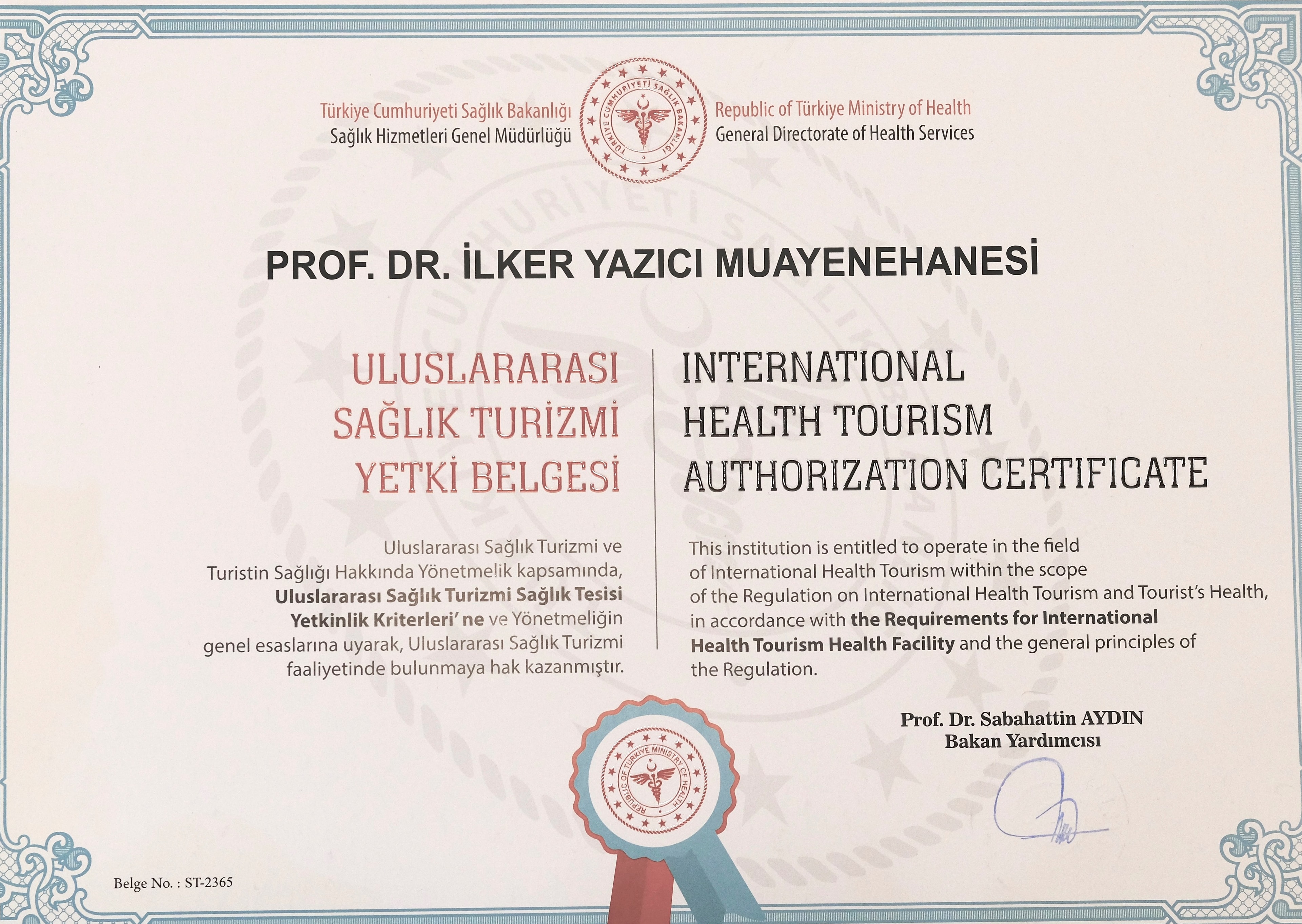
International Health Tourism Authorisation Certificate No. ST-2365

Prof. Dr. İlker Yazıcı Muayenehanesi
How it works, step by step
- 1. Sending information: Send photos of the area concerned, your age, a short note on your general health and what you would like to change by WhatsApp to +90 533 460 77 36 or by e-mail to info@ilkeryazici.com. This information is used to give you a general idea of the options, to tell you what else is needed and to estimate how long to plan your stay. It is not a medical assessment or a diagnosis; these take place at the examination in Nişantaşı.
- 2. Questions and planning: General questions about the procedure, the process and the recovery can be answered by phone, WhatsApp or e-mail. If you are able to come to Istanbul beforehand, you can also have a consultation at the practice in Nişantaşı before the surgery dates are set.
- 3. Planning the dates: The dates of your examination and surgery, the pre-operative tests, the length of your stay and the check-up days are agreed together. It is advisable to book your travel only once these dates are confirmed.
- 4. Arrival and examination in Nişantaşı: You are examined in detail at the practice. Where relevant, 3D imaging and simulation are used, the necessary tests are arranged, and the treatment plan and consent forms are reviewed with you. The decision to operate is confirmed only after this examination; if it shows that surgery is not right for you, it will not go ahead.
- 5. Surgery: Surgery takes place in an accredited partner hospital, with an anaesthesiologist present. The hospital stay depends on the procedure: some procedures are done as day surgery, others need one or more nights in hospital.
- 6. Recovery in Istanbul: Check-ups take place at the practice in the days after surgery, including dressing changes and the removal of splints or stitches where needed. Throughout this time you can reach the practice by phone and WhatsApp.
- 7. Return home and staying in touch: Before you leave, you have a final check-up and receive written care instructions. In the following weeks you stay in touch with the practice by sending photos and messages at agreed intervals; if something needs to be examined, a check-up in Istanbul or a visit to a local doctor is arranged.
- 8. Long-term follow-up: Results mature over several months. You keep in touch by photos and messages, and depending on how healing progresses, an in-person check-up in Istanbul may be recommended.
How long should you stay in Istanbul?
The length of your stay depends on the procedure, the extent of surgery, how you heal and how long your journey home is. The figures below are typical ranges; your personal plan is confirmed after the examination.
- Face and nose surgery: usually 5–10 days. Rhinoplasty, facelift and brow lift usually need about 7–10 days, eyelid and chin surgery about 5–7 days, and ear correction often less. Splints and stitches are usually removed within this period.
- Breast and body surgery (such as breast augmentation, breast lift or reduction, liposuction, tummy tuck): usually 5–10 days. For more limited procedures such as liposuction alone, gynaecomastia surgery or breast augmentation with the Preserve technique, 3–5 days may be enough.
- Combined procedures: when several procedures are done in one operation, the stay is usually longer and is planned entirely around you.
- Minor procedures under local anaesthesia: a shorter stay may be enough; where your stitches will be removed is discussed at the examination.
Planning your stay
One day before surgery is usually set aside for the pre-operative examination and tests, so add it to your stay. It is wise to keep your return date flexible and to confirm it only after the final check-up shows nothing that would prevent you from travelling.
Staying in touch after you return home
Once you are home, you stay in touch with the practice by sending photos and messages at agreed intervals. The intervals depend on the procedure; they are usually closer together in the first weeks and further apart in the following months. Taking the photos from the same angles and in similar light each time makes them easier to compare. If something needs to be examined, a check-up in Istanbul or a visit to a local doctor is arranged.
If something needs to be done where you live, such as a dressing change or a blood test, you will be told in writing how it should be done. Keep the summary documents of your surgery so that you can show them to a local doctor if needed.
Preparing for surgery
Smoking and other nicotine products slow wound healing and increase the risk of blood clots; you will be told how long to stop before and after surgery. If you develop a fever, an infection or a new health problem shortly before your surgery date, let the practice know before you travel, as surgery may need to be postponed. You may be asked to have some tests done at home and to send the results in advance. You will receive personal instructions about medicines that may need to be paused before surgery, such as blood thinners and some herbal products; do not stop any medicine on your own.
What to bring
Please bring the following with you. Sending your documents by WhatsApp or e-mail before you travel allows more accurate planning, and reports in a language other than Turkish or English may need a translation.
- Your passport or identity document
- Recent medical reports on any long-term conditions and your latest blood test results
- A list of the medicines, vitamins and herbal products you take regularly, with names and doses
- Operation notes or discharge summaries from any previous surgery, especially if you have had surgery on the same area before
- Relevant imaging results, if any (for example a breast ultrasound or mammogram report before breast surgery)
- Information or documents about any known allergies
- Comfortable clothes that open at the front, for after surgery
Languages
The practice communicates in Turkish and English. If you need another language, an interpreter can be arranged on request; simply mention it when you plan your visit.
Fees and your quote
The fee depends on the procedure and technique, the length of surgery, the type of anaesthesia, the hospital stay and the tests needed, so no prices are given on this website.
You receive a written, personalised quote that states what is included. The quote is finalised after the examination; if the plan changes, it is updated accordingly.
Safety: travel and blood clots
When you can fly or make a long road journey after surgery is decided individually, according to the procedure, the extent of surgery and how you are healing. The decision is made at your final check-up.
Long periods without moving increase the risk of blood clots in the leg veins (deep vein thrombosis) after surgery, and of a clot reaching the lungs (pulmonary embolism). This risk is assessed before surgery, including smoking, hormone-containing medicines, any previous clot and excess weight. To reduce the risk, you will usually be advised to:
- Start walking early after surgery, as instructed
- Drink enough fluids
- Wear compression stockings or a compression garment if recommended
- Get up often during the journey and move your legs and ankles
- If medication to prevent clots has been prescribed for you, take it without missing a dose
Warning signs
Shortness of breath, chest pain, or swelling or pain in one leg need urgent medical attention. If this happens, go to the nearest emergency department wherever you are and let the practice know.
Ministry of Health authorisation
The practice (Prof. Dr. İlker Yazıcı Muayenehanesi) is authorised by the Turkish Ministry of Health for international health tourism, under International Health Tourism Authorisation Certificate No. ST-2365. On request, help with accommodation near the clinic and airport transfer can be arranged through authorised partners.
Getting in touch
You can send your photos and a short description by WhatsApp to +90 533 460 77 36 or by e-mail to info@ilkeryazici.com, or use the other channels on the Contact page. How the information you send is processed is explained in the Privacy Policy.
Frequently asked questions
How many days do I need to stay in Istanbul for surgery?
It depends on the procedure. Patients having nose or facial surgery usually plan 7–10 days (eyelid surgery about 5–7), and those having breast or body surgery usually 5–10 days; combined procedures need longer. One further day is set aside before surgery for the examination and tests. You are given an approximate length of stay when you send your information, and it is confirmed after the examination in Istanbul.
When can I fly home after plastic surgery?
There is no single answer: the timing depends on the procedure, the extent of surgery, your risk of blood clots and how you are healing. The decision is made at your final check-up in Istanbul, so keep your return date flexible. On long journeys, moving regularly, drinking enough fluids and wearing compression stockings if advised help to reduce the risk of clots.
Can I combine several procedures in one operation?
Some procedures can be done together, for example certain breast and abdominal procedures, or several procedures on the face. The decision depends on the total length of surgery, your general health, your risk of blood clots and the overall recovery. Combined procedures mean a longer stay in Istanbul. Which combinations are appropriate for you is decided at the examination.
What happens if there is a complication after I go home?
You can still reach the practice by WhatsApp, phone or e-mail after you return home, and you can send photos of the area concerned. If something needs to be examined, you may be asked to see a local doctor or to go to an emergency department, so keep the written documents about your surgery with you. If needed, a check-up in Istanbul is arranged.
Can the first consultation take place online?
No. Before you travel you can send photos and information by WhatsApp or e-mail; they are used to give you a general idea of the options and of how long to plan your stay, and to answer your questions about the process. This is not a medical consultation: the medical assessment and the decision about surgery take place at the examination at the practice in Nişantaşı.
How do I send photos before my visit?
Send them by WhatsApp to +90 533 460 77 36 or by e-mail to info@ilkeryazici.com. Clear photos taken in daylight against a plain background, without make-up or filters, showing the area from the front, the side and at an angle are the most useful. Your photos are used only to plan your visit and treatment and are not published without your explicit consent.
When will I receive a quote?
The fee depends on the procedure, the technique, the length of surgery and hospital stay, and the tests needed. You receive a written, personalised quote that states what is included; it is finalised after the examination and updated if the plan changes. An exact fee cannot be given before the examination, because procedures with the same name can differ in extent from one person to another.
Which languages does the practice speak?
The practice communicates in Turkish and English. If you need another language, an interpreter can be arranged on request. Mentioning this in your first message makes it easier to plan the examination and surgery days around it. Your care instructions and the content of the consent forms are explained to you until nothing is left unclear.
Do I need to come back to Istanbul for check-ups?
The first check-ups take place while you are still in Istanbul. After that, you stay in touch by sending photos and messages at agreed intervals. Depending on how healing progresses, or once the result has matured, an in-person check-up may be recommended. If so, its timing is planned with you around dates that suit you.
Can I travel to Istanbul alone?
For operations under general anaesthesia in particular, it is advisable to have a relative or friend with you for the first days. In the first days after surgery your movement may be limited, and you will need to take your medicines regularly and attend check-ups. If you are planning to travel alone, mention it in your first message so that your plan takes it into account.
Last updated: · Responsible for content: Prof. Dr. İlker Yazıcı · info@ilkeryazici.com
Get in touch to plan a consultation
Send your questions and photos via WhatsApp and arrange a convenient day for your consultation.